
30 Lenses per box
30 Lenses per box
3 Lenses per box
3 Lenses per box
12 Lenses per box
12 Lenses per box
3 Lenses per box
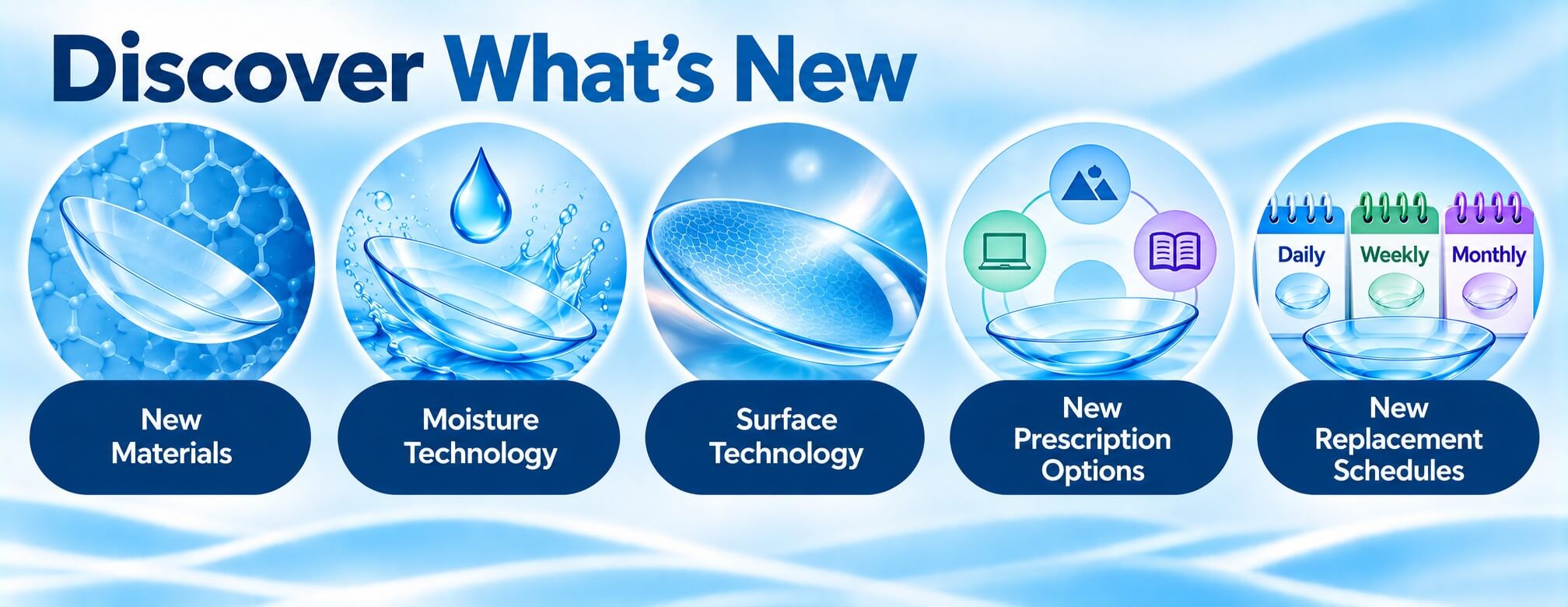
Contact lens technology continues to develop, with newer lenses introducing different materials, moisture technologies, replacement schedules and designs for more complex prescriptions.
New doesn't automatically mean better. If your current lenses provide clear vision and remain comfortable for as long as you need them, there may be no reason to change. But newer contact lenses can offer options that weren't available when you were originally fitted — and that can be particularly useful if your lifestyle, prescription or comfort needs have changed.
This page highlights some of the newer additions to our contact lens range and, more importantly, what they offer that's different.
It can be tempting to assume that the newest contact lens must be an upgrade, but contact lenses don't work quite like phones or computers.
A newer material or technology is useful when it offers something that suits your eyes or solves a problem with your current lenses. That might be improved surface moisture, a different replacement schedule, better vision for astigmatism or presbyopia, or simply another lens design for your optometrist to consider.
If you're interested in trying a newer lens, ask your optometrist whether its features would provide a genuine benefit for you.
John Dreyer BSc (Hons), MCOptom, DipCL
Optometrist & Clinical Content Reviewer
The most interesting thing about a new contact lens isn't how recently it appeared — it's what has changed.
New materials may offer a different balance of breathability, flexibility, water content and handling.
Moisture and surface technologies continue to develop too. Some newer lenses focus on maintaining a highly wettable surface, while others incorporate technologies designed to release or retain moisture during wear.
New prescription options can be particularly important. A technology that was initially available only in a standard spherical lens may later become available for astigmatism or presbyopia, giving more people access to it.
A new version may also extend the power, Cyl or Add range available for toric or multifocal prescriptions, so it's worth checking occasionally if a lens you were previously unable to wear has become available for your prescription.
Replacement schedules can change as well. Daily, two-weekly and monthly lenses are familiar, but newer weekly lenses now provide another option between daily disposables and longer reusable schedules.
And finally, look at whether a new lens actually provides a useful difference for you. New technology is most valuable when it improves something that matters to the wearer.
Precision7 – A silicone hydrogel lens with a weekly replacement schedule, sitting between daily disposables and longer reusable lenses. Its ACTIV-FLO System combines a wetting agent within the lens with a replenishing agent that is gradually released during the wearing period.
Precision7 for Astigmatism – Extends the weekly replacement concept to people with astigmatism. Alongside ACTIV-FLO moisture technology, it uses a toric design intended to help stabilise the lens and maintain consistent vision.
Precision1 – A silicone hydrogel daily disposable using SMARTSURFACE Technology, which creates a thin, moisture-rich layer at the lens surface. It is a good example of newer lens development focusing not simply on the core material but on the surface that interacts with the tear film and eyelids.
Precision1 for Astigmatism – Brings the Precision1 daily platform to toric wearers, combining moisture-focused surface technology with astigmatism correction.
TOTAL30 – A monthly silicone hydrogel lens that brings water-gradient technology into a reusable replacement schedule, combining a breathable lens core with a highly water-rich surface.
TOTAL30 for Astigmatism – Extends the TOTAL30 platform to toric prescriptions, combining Water Gradient and surface technologies with a stabilising toric design.
TOTAL30 Multifocal – Brings the same monthly water-gradient approach to people with presbyopia, combining surface technologies with a multifocal design for near, intermediate and distance vision.
Don't change contact lenses just because something newer has appeared.
Instead, ask what the new lens does differently.
Does it offer a replacement schedule that suits you better? Is your prescription now available in a lens technology you couldn't previously wear? Does it address a comfort problem you've been experiencing?
If the answer is yes to any of these, it may be worth discussing with your optometrist. If your existing lenses already give you comfortable, clear vision, there may be no advantage in changing simply for the sake of having something newer.
Not automatically.
Newer lenses may introduce different materials, surface technologies, replacement schedules or prescription options, but an established lens that fits well and provides comfortable, clear vision can still be an excellent choice.
What matters is whether the newer lens offers a benefit that's relevant to you.
New contact lenses are usually promoted by manufacturers through advertising campaigns, product announcements and newsletters, and your optometrist may also tell you about newer options that could suit your prescription or wearing needs.
Retailers may highlight new additions to their ranges too, which is one reason we keep this page updated with some of the newer lenses available from ContactLenses.co.uk.
Remember that a new version may also extend an existing lens technology into toric or multifocal prescriptions, so it's worth checking occasionally if a lens you were previously unable to wear has become available for your prescription.
Developments often focus on areas such as silicone hydrogel materials, moisture retention, highly wettable surfaces, deposit resistance and more specialised optical designs.
But don't judge a lens by the number of technologies it advertises. The useful question is whether those features address something that matters to your eyes or wearing habits.
Yes. Although daily, two-weekly and monthly replacement schedules remain common, weekly replacement lenses provide another option.
Newer seven-day replacement lenses give wearers an alternative between a fresh daily lens and a longer reusable schedule.
Yes. New lens technologies are increasingly available beyond standard spherical prescriptions.
Newer lens families may include toric versions for astigmatism and multifocal versions for presbyopia, meaning technologies that were previously unavailable for your prescription may become an option later.
You shouldn't assume that a newer lens with the same prescription numbers will fit or perform in the same way as your existing lens.
Different materials, dimensions and designs can behave differently on the eye. Your optometrist can assess whether the new lens is suitable, check its fit and make sure your vision and eye health remain satisfactory.
